Do your website visitors leave before finishing your newest post? Most people skim online pages instead of reading every single word.
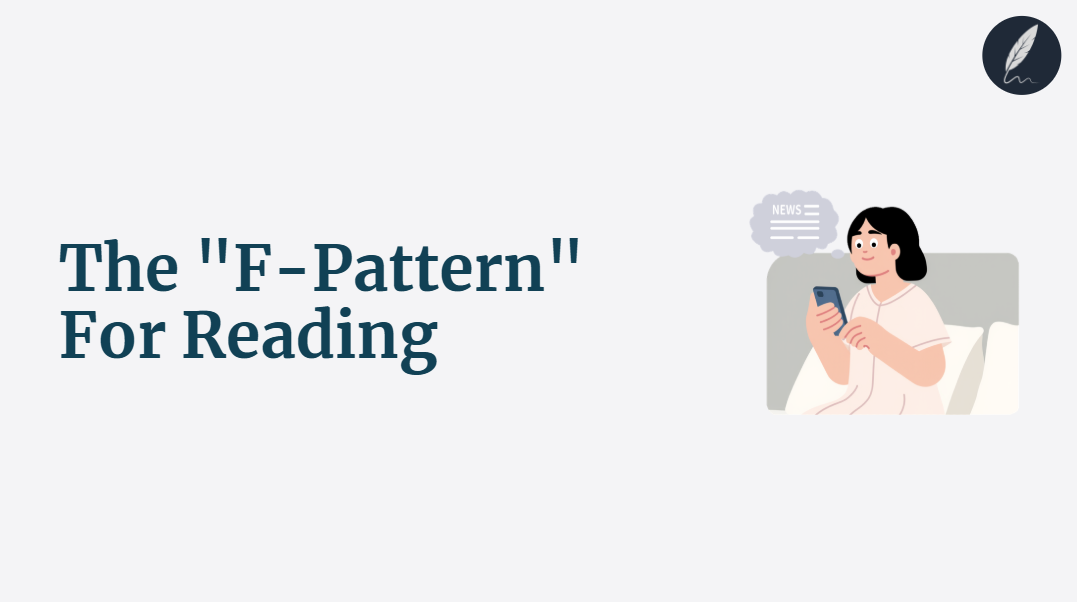
This common habit is called F-pattern reading.
You can easily transform casual scanners into eager readers. Use smart formatting rules to make your writing stand out instantly. Discover exactly how to keep your audience hooked!
Key Takeaways
- Understand The F-Pattern: Readers naturally scan in an F-shape when pages lack formatting anchors or visual breaks.
- Break The Default Habit: This scanning behavior is merely a symptom of poor layout, not a permanent reading style.
- Embrace Modern Patterns: Use distinct layer-cake and spotted layout methods with descriptive subheadings to guide eyes effectively.
- Format For Skimmers: Front-load your main value and write short, punchy paragraphs to capture real audience engagement.
- Optimize Page Layout: Leverage AI tools like Orwellix to simplify dense text blocks and maintain readable structures.
What is the F-Pattern in Web Reading?
The F-Pattern describes the most common eye-scanning path users take when looking at content that lacks clear formatting anchors. It is a dominant behavior characterized by specific horizontal and vertical eye movements. When visitors land on your page, they rarely read line-by-line, instead they scan for value signals.
The Legacy of the Nielsen Norman Group Study
First identified in 2006, this behavior was documented in a landmark eye-tracking study by the Nielsen Norman Group. The researchers recorded how more than 230 users looked at thousands of web pages. The heatmaps revealed a consistent shape resembling the letter ‘F’, a finding that fundamentally changed how we understand web reading behavior.
- Top Bar: Users first read in a horizontal movement, usually across the upper part of the content area. This forms the F’s top bar.
- Lower Bar: Next, they move down the page a bit and read across in a second horizontal movement that typically covers a shorter area than the previous one.
- The Stem: Finally, users scan the content’s left side in a vertical movement. This creates the F’s stem.
This study highlighted a harsh reality for content creators: on an average visit, users read only about 20% to 28% of the words on a page. This isn’t necessarily laziness, it is a profound efficiency strategy. In a world of information overload, the F-pattern is the path of least resistance, the default baseline behavior users revert to when a page offers no better way to find what they need.
The F-Pattern is a Symptom of Poor Writing
Most conventional writing advice treats F-pattern reading as a permanent, unchangeable human trait. But here is the hard truth: readers do not naturally want to skim in an F-shape. They adopt this predictable page scanning behavior only when they smash into a formatting-free wall of text. The F-pattern is not a reading style, it is a symptom of poor writing and preventable blog post writing mistakes.
When a web page lacks clear anchors, cognitive load increases dramatically. According to research on how people read online by the Nielsen Norman Group, users typically leave a web page in 10 to 20 seconds unless they immediately see the core value. If you do not give them a transparent reason to care, their eyes revert to the F-pattern, the path of least resistance.
High-quality, relevant writing transforms a casual scanner into an engaged deep reader. You can break this default behavior and earn their attention by focusing on UX writing best practices:
- Start with a Sharp Hook: Give readers a compelling reason to stop scanning and start reading within the very first sentence.
- Deliver Clear Value Signals: Highlight exactly what the reader will learn or gain using bold text and smart formatting.
- Respect Their Time: Cut the fluff and deliver the core message quickly, keeping sentences punchy, active, and direct.
Dense paragraphs encourage F-scanning. However, when you use smart content layout, readers actually slow down to absorb your message.
For instance, using tools like Orwellix to transform a dense, massive block of text into an active, scannable format invites actual reading rather than mere skimming. We will explore exactly what this looks like later in the article.
Beyond the F-Pattern: Modern Web Reading Behaviors
The Layer Cake, Spotted, and Z-Patterns
The F-pattern might be the default for poorly formatted text, but it is far from the only way users consume digital content. When you structure a web page effectively, readers naturally transition into more efficient reading patterns on websites.
According to comprehensive eye-tracking research on text scanning patterns by the Nielsen Norman Group, users exhibit multiple distinct behaviors depending on the layout and their specific goals.
Understanding these alternative patterns allows UX writers and content creators to design content that guides the eye exactly where it needs to go. Here are three modern page scanning behaviors that emerge when you optimize your content layout:
- The Layer Cake Pattern: This is the most effective pattern for well-structured articles. Readers scan straight down the page, reading only the distinct headings and subheadings until they find the exact section they need. Once they find relevant information, they stop and read horizontally.
- The Spotted Pattern: This occurs when users scan for specific visual anchors. Their eyes bounce around the page looking for bolded words, bullet points, numbers, or specific terms that jump out from the surrounding text.
- The Z-Pattern: Most commonly seen on landing pages, a user’s visual flow zig-zags horizontally across the top, diagonally down to the left, and horizontally across the bottom, moving naturally between text blocks and images.
The layer-cake format is particularly powerful for long-form content. Studies show that clear, descriptive subheadings help readers find information faster and engage more deeply. This means your subheadings must carry the weight of your core message.
By formatting your content to encourage layer-cake or spotted scanning, you eliminate the cognitive fatigue associated with dense walls of text. Instead of fighting against how people read online, you are working intuitively with their natural instincts to find valuable information quickly and efficiently.
How to Format Content for Skimmers (The Right Way)
Front-Loading Keywords and Meaningful Subheadings
When learning how to format content for skimmers, the most powerful tool in your arsenal is inverted pyramid writing. Instead of building up to a dramatic conclusion, you must start your introduction and main body paragraphs directly with the main point. You should never bury the lead.
According to foundational usability research by the Nielsen Norman Group, front-loading your content significantly improves reader comprehension and encourages deeper engagement. Here is how to apply this to your writing for the web structure:
- Lead With Value: Place the most critical, actionable information in the very first sentence.
- Write for Scanners: Use highly descriptive subheadings that tell a complete, compelling story even if the user never reads the body text.
- Use Active Voice: Keep your phrasing energetic and direct to maintain reader momentum.
If you ever struggle to simplify complex ideas, Orwellix’s AI Agent Mode can instantly rewrite a passive, dense paragraph into an active, front-loaded format specifically tailored for web readers.
Structuring Paragraphs to Hold Attention
Once your headings are optimized, you need to focus heavily on paragraph layout. Long, uniform blocks of text immediately trigger the F-pattern. To maintain active reading, you need to incorporate visual pauses and vary your sentence length using standard UX writing best practices:
- Break the Flow: Use one-sentence paragraphs to create stark visual pauses and emphasize important ideas.
- Bold the Core: Highlight the single most important concept in a larger paragraph so drifting eyes naturally catch the takeaway.
- Rhythm Variation: Mix punchy, short sentences with slightly longer explanatory ones to keep the reader engaged and reading rhythmically.
The 3-Line Rule for Mobile Readers
It is absolutely crucial to do a mobile reality check on your content. Since over 55% of global website traffic comes from mobile devices, short desktop paragraphs quickly turn into intimidating walls of text on smartphone screens.
To prevent readers from dropping off or reverting to default page scanning behaviors, strictly apply the 3-line rule. Keep your paragraphs to a maximum of three lines on your desktop view. This clear, actionable insight ensures your content remains inviting and digestible across all screen sizes.
Before and After: Defeating the F-Pattern
Case Study: A Standard SaaS Blog Introduction
To truly understand how to format content, we must look at a practical example. Let us examine a typical SaaS blog introduction that accidentally encourages the F-pattern reading style rather than deep engagement.
[Welcome to our comprehensive guide on content marketing. In this article, we are going to discuss why content is king and how it can help your business grow over time. Many companies struggle with creating good content. But with the right strategy, you can attract new customers, build brand awareness, and eventually increase your monthly recurring revenue. Read on to learn more.]
When confronted with this dense wall of text, readers instantly abandon line-by-line reading. According to the original Jakob Nielsen eye tracking study, users looking at text like this will only read the first line. Because web users spend 69% of their viewing time on the left half of the page, they will simply scan down the left margin and miss the core message completely.
The Orwellix Rewrite Strategy
Instead of blaming the reader, we must fix the web structure. Using Orwellix, we can quickly transform this ineffective paragraph into a high-converting layout that respects the reader’s time and implements smart content layout for better engagement.
- The Sharp Hook: Start with a bold, one-sentence statement that quickly commands attention and stops the scrolling eye.
- The Value Signal: Break out your core benefits into clear points so the eyes naturally spot the value.
- Active Voice: Strip away the passive filler words to make every sentence punchy and energetic.
Applying these UX writing best practices creates an entirely new reading experience. Here is the same introduction, completely rewritten and formatted for actual human readers:
[Content marketing is the most reliable way to scale your recurring revenue.
By implementing our proven strategy, you will quickly:
- Attract high-intent customers.
- Build undeniable brand authority.
- Increase your bottom line.]
This revised format forces the user to break their traditional scanning mold. Because the layout uses visual pauses and bold emphasis, readers actually stop to absorb your message deeply. You have successfully designed the content to work with human psychology rather than fighting against it.
Using Orwellix to Optimize Page Layout
Once you understand the mechanics of visually structured content, the next step is applying these UX writing best practices at scale. Manually checking every single sentence for cognitive load and reading difficulty is an exhausting process.
Research shows that simple, accessible writing drastically improves user retention. According to usability guidelines on reading levels by the Nielsen Norman Group, targeting an 8th-grade reading level guarantees your content serves the broadest possible audience. If you are choosing a dedicated readability tool for blog posts, compare the best readability checkers for bloggers.
Content teams improving campaign assets should compare the best readability checker for content marketers. If the real decision is how to enforce one clarity standard across multiple writers and editors, compare the best readability tool for content teams. SEO writers optimizing articles for scanners and search intent should compare the best readability checker for SEO writers.
Writers who need a general editing workflow can use the readability checker for writers comparison instead. Academic writers adapting papers or abstracts for broader readers should compare the best readability checker for academic writing.
Technical writers formatting product docs, help-center content or user guides should compare the best readability checker for technical writers.
If you want a broader AI tool that scores, highlights, and simplifies in one place, see our guide to the best AI writing tool for improving clarity. Orwellix automatically helps you enforce these standards to prevent negative page scanning behaviors.
Built-in Readability and Scanning Tools
Here is how you can leverage the editor’s core features to completely transform your writing for the web structure:
- Color-Coded Highlights: Use real-time Yellow and Red highlights to instantly identify lengthy sentences that cause immediate visual fatigue.
- Agent Mode Fixes: Seamlessly prompt the AI Agent to rewrite dense paragraphs into a highly scannable, active format directly inside the editor.
- Target Grade Score: Monitor the strict built-in metrics to maintain your target readability grade across every single section.
By integrating these automated tools into your publishing routine, you turn intimidating walls of text into inviting, high-converting assets. Your readers get the information they need efficiently, and your content finally earns the deep engagement it deserves.

Write smarter with Orwellix
The Orwellix AI Capabilities that helps you craft clearer, more effective content.
Conclusion
In conclusion, overcoming the F-pattern reading habit requires a fundamental shift in how we structure digital content. As we have explored, the F-pattern is merely a symptom of poor layout rather than an unchangeable user trait. By embracing modern reading behaviors like the layer-cake pattern, formatting strategically for skimmers, and front-loading your core value, you drastically reduce cognitive load.
Looking ahead, the implications for content creators are profound. As digital distractions multiply, optimizing your writing for the web structure is no longer optional, it is essential for business survival and audience retention. Navigating this evolving landscape is much easier when supported by the right technology.
Implementing the Orwellix platform into your daily workflow naturally bridges this gap, helping you automatically enforce readable structures and defeat intimidating text walls without acting as a disruptive, pushy interruption.
Ultimately, successful content marketing is not just about the quality of what you say, but exactly how you visually present it. When you design your layout to accommodate natural scanning habits, you stop fighting against human psychology and start securing a lasting competitive advantage.
Frequently Asked Questions (FAQs)
1. What is the difference between the F-pattern and the Z-pattern?
The F-pattern happens organically when readers face dense text, causing them to scan the left margin and miss the core message. In contrast, the Z-pattern is an actively designed layout typically used on landing pages that naturally guides the user’s eye from side to side across images and short text blocks.
2. How do I know if my blog post is triggering the F-pattern?
Look at your content strictly on a mobile screen. If you see massive block paragraphs without bold text, descriptive subheadings, or bullet points, you are almost certainly forcing your readers into a default F-pattern scan.
3. Does formatting for skimmers hurt my SEO rankings?
No, writing for skimmers actually improves your SEO. Search engines highly reward pages with strong user engagement and lower bounce rates. By using clear subheadings, bullet points, and front-loaded keywords, you keep humans reading longer while giving search engine crawlers precise contextual signals.
4. Why is the “inverted pyramid” method effective for web writing?
The inverted pyramid is effective because it immediately gives the reader what they came for. By placing your most valuable, actionable information in the very first sentence, you capture attention instantly instead of forcing visitors to hunt for the core point.
5. What is the fastest way to fix a dense “wall of text”?
The fastest approach is to isolate the main benefit, bold it, and break the supporting details down into a distinct bulleted list. You can also enforce the strict 3-line rule or leverage AI tools like Orwellix to automatically convert dense paragraphs into scannable elements.
Try Orwellix Free for 7 Days
Experience Orwellix AI Agent's capabilites with risk-free trial. Full access to all features for 7 days. Credit card required to start, you won't be charged until the trial ends.
Start Your Free Trial